
Introduction to PVC Pipe Manufacturing Machines
PVC pipe manufacturing machines play an essential role in the modern plastic processing industry. PVC (Polyvinyl Chloride) pipes are widely used in residential construction, commercial buildings, agriculture, irrigation, water supply, drainage, and industrial applications. With the increasing demand for durable, lightweight, and cost-effective piping solutions, the need for advanced PVC pipe extrusion machines is growing across domestic and international markets.
A PVC pipe manufacturing machine is specially designed to convert raw PVC material into high-quality pipes of different diameters, thicknesses, and lengths. These machines use advanced extrusion technology to ensure consistent production, dimensional accuracy, and reliable product quality.
Manufacturers such as Hasmukh Engineering Works contribute to the plastic machinery industry by providing pipe extrusion solutions designed to meet different production requirements. Selecting the right PVC pipe machine can help businesses improve productivity, maintain quality, and build a competitive position in the market.
What Is a PVC Pipe Manufacturing Machine?
A PVC pipe manufacturing machine is an industrial production system that transforms PVC raw materials into finished pipes through a continuous extrusion process. Depending on the machine configuration, it can manufacture pipes in various sizes for plumbing, agriculture, electrical conduit, drainage, and other applications.
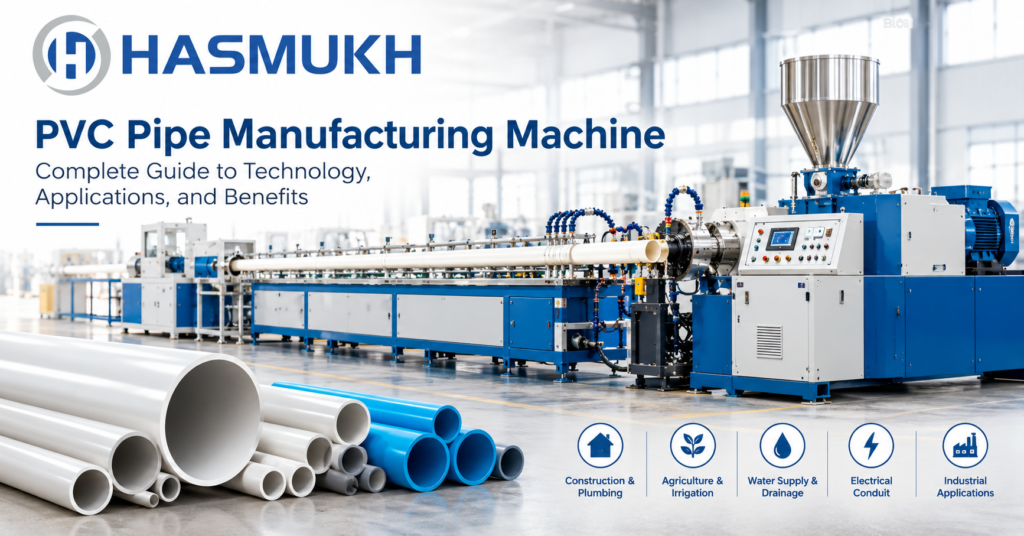
A typical PVC pipe extrusion line consists of several integrated components, including a raw material mixing system, extruder, pipe die, vacuum calibration tank, cooling tank, haul-off unit, cutting machine, and pipe stacking system.
Each component performs a specific function in the production process. When these components work together efficiently, they help produce pipes with uniform wall thickness, a smooth surface, accurate dimensions, and the required mechanical properties.
How Does a PVC Pipe Extrusion Machine Work?
The PVC pipe manufacturing process involves several important stages.
1. Raw Material Preparation
The process begins with preparing PVC resin and other suitable additives. Depending on the intended pipe application, the formulation may include stabilizers, processing aids, lubricants, pigments, and impact modifiers.
Proper mixing is important because it helps achieve consistent material properties and stable processing conditions.
2. Material Feeding and Extrusion
The prepared PVC compound is fed into the extruder. Inside the machine, rotating screws transport, mix, and process the material under controlled temperature and pressure conditions.
The extruder is a critical component because its screw design, barrel configuration, temperature control, and processing stability influence production performance.
3. Pipe Die Formation
After processing, the material passes through a specially designed pipe extrusion die. The die shapes the processed PVC compound into a continuous hollow pipe.
The die design and operating conditions must be suitable for the required pipe diameter, wall thickness, and product specification.
4. Vacuum Calibration
The newly extruded pipe enters a vacuum calibration tank, where the vacuum system and calibration sleeve help maintain the required outside diameter and roundness.
Accurate calibration is essential for producing pipes that meet dimensional requirements.
5. Cooling Process
The pipe passes through cooling tanks, where water removes heat and helps the pipe retain its shape. Proper cooling improves dimensional stability and supports consistent production at the required line speed.
6. Haul-Off and Cutting
A haul-off unit pulls the pipe through the production line at a controlled speed. The cutting machine then cuts the continuous pipe into predetermined lengths.
Depending on the production requirements, the line may include automatic measuring and cutting controls.
7. Inspection and Packaging
The finished pipes are inspected for diameter, wall thickness, surface quality, and other applicable specifications. After quality checks, the pipes are marked, stacked, and prepared for storage or dispatch.
Types of PVC Pipe Manufacturing Machines
Different applications require different machine configurations. Common types include:
1. UPVC Pipe Manufacturing Machine
UPVC (Unplasticized Polyvinyl Chloride) pipe extrusion lines are widely used to manufacture rigid pipes for water distribution, plumbing, irrigation, and drainage systems. These machines are designed to process suitable rigid PVC compounds.
2. CPVC Pipe Manufacturing Machine
CPVC (Chlorinated Polyvinyl Chloride) extrusion systems manufacture pipes intended for applications such as hot and cold water distribution. Processing conditions and material formulations must be appropriate for CPVC.
3. PVC Electrical Conduit Pipe Machine
These machines produce conduit pipes used to protect electrical wiring in residential, commercial, and industrial installations.
4. PVC Drainage Pipe Machine
Drainage pipe extrusion lines manufacture pipes used for wastewater management, building drainage, and related infrastructure applications.
5. High-Speed PVC Pipe Extrusion Line
High-speed production lines are designed to improve output while maintaining suitable dimensional control and product quality. Actual production capacity depends on pipe size, wall thickness, material formulation, and machine configuration.
Key Features of a Modern PVC Pipe Manufacturing Machine
When choosing a PVC pipe extrusion machine, manufacturers should consider several important features.
- Efficient extrusion system: A suitable screw and barrel design helps achieve stable processing and consistent material output.
- Temperature control: Accurate heating and cooling controls support reliable processing conditions.
- Vacuum calibration system: Proper calibration helps maintain pipe diameter and shape.
- Efficient cooling tanks: Well-designed cooling systems support dimensional stability.
- Reliable haul-off unit: Controlled pulling speed helps maintain consistent pipe dimensions.
- Automatic cutting system: Automated cutting improves production convenience and length accuracy.
- User-friendly controls: Modern control systems simplify machine operation and monitoring.
- Energy efficiency: Suitable motors, drives, heaters, and system design can help reduce energy consumption per unit of production.
The most appropriate features depend on the manufacturer’s production targets, available space, budget, and product range.
Applications of PVC Pipes
PVC pipes are used across numerous industries because they are lightweight, corrosion-resistant, and available in a wide range of sizes and specifications.
Major applications include:
- Residential and commercial plumbing
- Agricultural irrigation systems
- Water supply networks
- Electrical cable protection
- Building drainage systems
- Wastewater management
- Industrial fluid handling, where material specifications permit
- Infrastructure and construction projects
The versatility of PVC pipes creates opportunities for manufacturers serving construction companies, distributors, plumbing suppliers, agricultural businesses, and infrastructure contractors.
Benefits of Investing in a PVC Pipe Manufacturing Machine
Setting up a PVC pipe production facility can offer several advantages when supported by market research and effective manufacturing management.
Consistent production: A properly configured extrusion line helps maintain uniform pipe dimensions and repeatable quality.
Wide product range: Suitable machine configurations and interchangeable tooling can allow manufacturers to produce different pipe diameters and specifications.
Production efficiency: Automated feeding, calibration, cutting, and handling systems can reduce manual intervention.
Long-term business opportunities: Demand from construction, plumbing, agriculture, and infrastructure sectors can create opportunities for established manufacturers and new businesses.
Scalable operations: Businesses can select production equipment based on current requirements and expand capacity as demand grows.
However, profitability depends on raw material prices, electricity costs, machine investment, labour, maintenance, market demand, distribution, and competition. A detailed feasibility study is recommended before establishing a manufacturing unit.
How to Choose the Right PVC Pipe Machine Manufacturer
Choosing an experienced machine manufacturer is an important step when investing in a PVC pipe production line.
Before purchasing, evaluate the following factors:
- Manufacturing experience: Review the supplier’s experience in plastic pipe extrusion machinery.
- Production capacity: Confirm that the proposed line can meet your required output for the intended pipe sizes.
- Pipe specifications: Discuss diameter ranges, wall thicknesses, material types, and applicable quality standards.
- Machine configuration: Check the extruder, die, calibration system, cooling tanks, haul-off, and cutting equipment.
- After-sales support: Ask about installation, commissioning, operator training, spare parts, and technical assistance.
- Energy and operating costs: Compare the estimated total cost of ownership rather than considering only the purchase price.
- Quality assurance: Review inspection procedures, dimensional control, and relevant product certification requirements.
A reliable supplier should explain the machine configuration clearly and recommend equipment suited to your actual production requirements.
Why Consider Hasmukh Engineering Works?
Hasmukh Engineering Works is a name to consider when exploring plastic pipe extrusion machinery and manufacturing solutions. Businesses researching PVC, UPVC, and CPVC pipe production equipment should discuss their production requirements with the company and evaluate the available machine configurations.
Before finalizing an order, prospective buyers should confirm the available pipe size range, production capacity, automation options, energy requirements, installation services, warranty conditions, and after-sales support directly with the manufacturer.
Selecting equipment that matches your target market and production objectives can help establish a more efficient and sustainable manufacturing operation.
Conclusion
PVC pipe manufacturing machines are an important part of the plastic processing industry, supporting the production of pipes used in construction, plumbing, irrigation, drainage, and electrical installations. A complete PVC pipe extrusion line combines extrusion, die formation, vacuum calibration, cooling, haul-off, cutting, and quality inspection to produce finished pipes efficiently.
For businesses planning to enter the plastic pipe manufacturing sector or expand existing operations, investing in the right machinery is essential. Careful evaluation of machine specifications, operating costs, technical support, and market demand can help improve production performance and long-term business prospects.
By understanding the manufacturing process and selecting suitable equipment, manufacturers can develop reliable production capabilities and serve the growing needs of the PVC pipe industry.
Looking for a PVC pipe manufacturing machine? Contact Hasmukh Engineering Works to discuss your production requirements and explore suitable pipe extrusion line configurations.